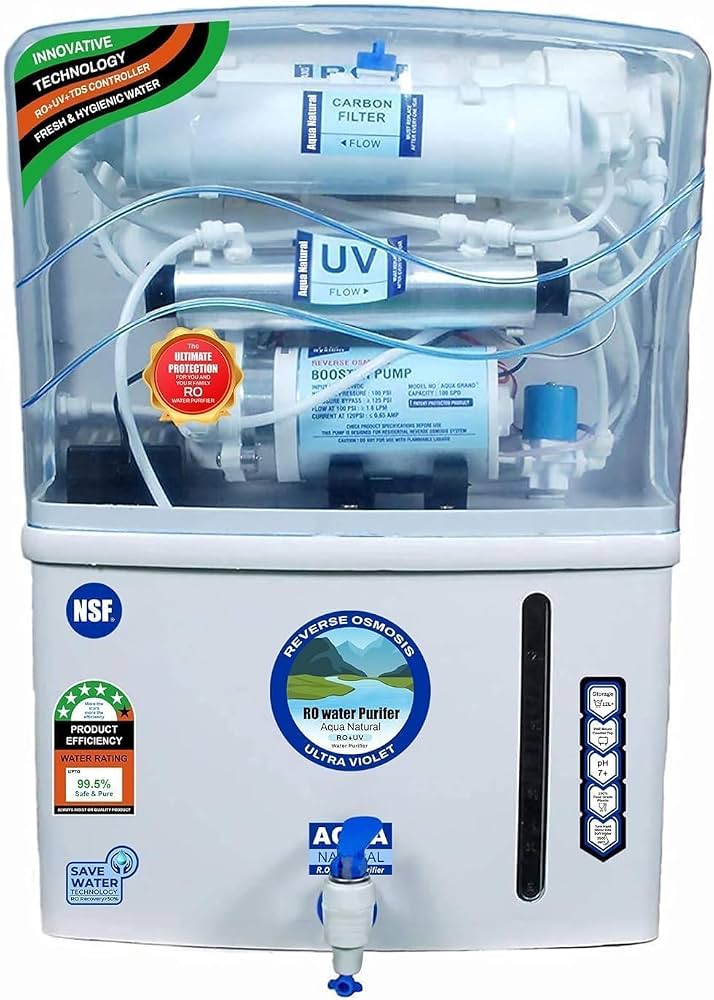
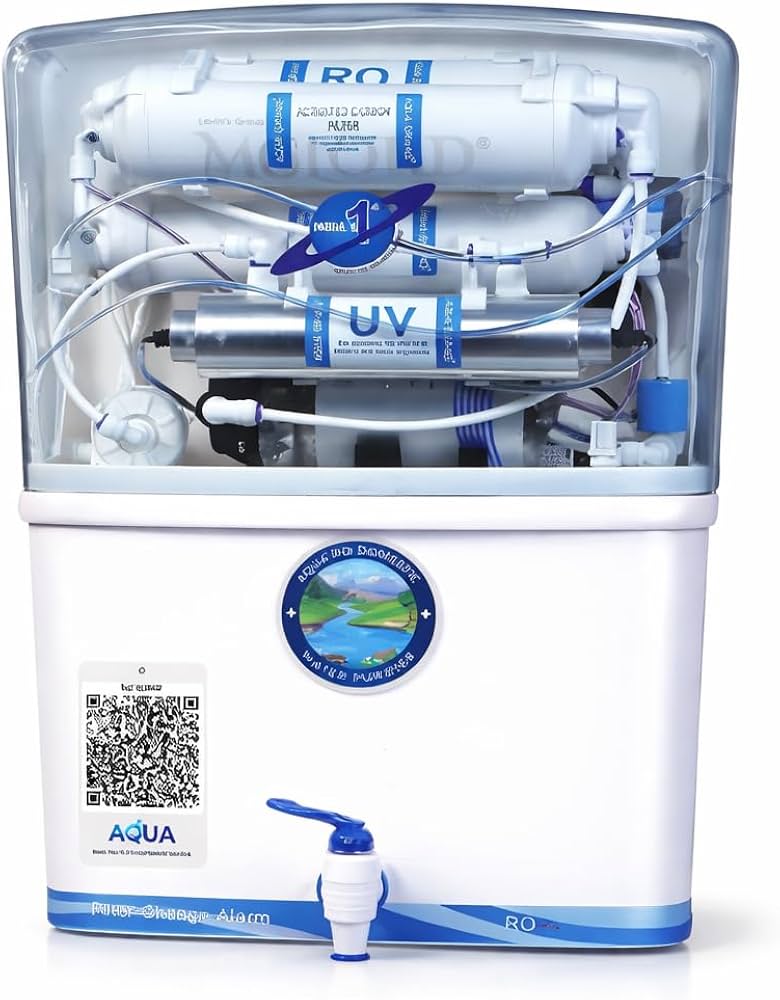
Under Sink vs Wall Mounted Water Purifiers: Which is Right for You?
When it comes to choosing a water purifier for your home, there are many factors to consider, including the type of purifier, the size of the unit, and the installation location. Two popular options are under-sink water purifiers and wall-mounted water purifiers, each with its own set of benefits and... Read more"Under Sink vs Wall Mounted Water Purifiers: Which is Right for You?"
3 Best Under Sink RO Water Purifiers in India – Reviews
Water purifiers have become an integral part of our lives. Today I am going to talk about a type of water purifier that is not so common in Indian homes. Unlike India, under-sink water purifiers are the preferred choice for homes in the U.S. and Europe. However, these water purifiers... Read more"3 Best Under Sink RO Water Purifiers in India – Reviews"
RO Water Purifiers
According to a World Bank report, “water quality in India has deteriorated as a result of an uncontrolled discharge of raw domestic and industrial waste-water”. Indian cities are lagging behind in providing reliable, sustainable, and affordable water supply. Due to these disturbing trends, people are finding RO purifiers as the... Read more"RO Water Purifiers"
RO+UV Water Purifiers
According to The Hindu (March 2010), “Polluted drinking water claim more lives than all forms of violence, including war”. Therefore, it is a crying need of the hour to utilize an effective purification technology in the form of RO and UV that removes harmful impurities as well as deadly germs... Read more"RO+UV Water Purifiers"
RO+UV+UF Water Purifiers
In India, pure, safe and clean water is really hard to find today. In most Indian households water is supplied by the municipality, which is not best suited for drinking purposes. This has led to an increased demand for RO+UV+UF water purifiers. Let us find out why and when to... Read more"RO+UV+UF Water Purifiers"
How to Find Govt Approved Water Testing Lab Near Me
What is the Need for Testing Drinking Water? At the time of writing this post (19th July 2022), the total number of water samples, tested in India by the Govt. approved water testing labs, was 58,95,420. (Source: JJM-WQMIS) Out of these total samples, 8,47,708 samples were found contaminated. This means... Read more"How to Find Govt Approved Water Testing Lab Near Me"
Air quality in western Singapore deteriorated to the “very unhealthy” category on Tuesday, October 20, 2026, due to transboundary haze from fires in Kalimantan and Sumatra. Singapore’s National Environment Agency (NEA) warned that the risk of severe haze persists, while the pollution index is expected to remain at “unhealthy” to “very unhealthy” levels through Sunday.
NEA data showed the 24-hour Pollutant Standards Index (PSI) ranged from 129 to 212 at 11:00 p.m. The highest readings were recorded in the western region, while hourly PM2.5 readings reached 185 in the west, 113 in the central region, and 133 in the south of Singapore.
For most of Saturday, all three regions were in the “high” category, with PM2.5 concentrations ranging from 151 to 250 micrograms per cubic meter. At 11:00 a.m., only the western region fell into that category, with a reading of 158.
Conditions have improved compared to Friday, when the PSI reached 229—the highest level this year—and entered the “very unhealthy” category. However, the NEA warned that dry weather conditions in parts of the southern ASEAN region could keep the risk of haze high in the coming days.
In its haze update on Saturday night, the NEA stated that winds from the southeast were still carrying smoke from fires in Kalimantan toward Singapore. The agency also observed the presence of haze over Sumatra.
The NEA forecasts that winds on Sunday will shift to blowing from the southeast or south. This change in wind direction has the potential to reduce the movement of haze from Kalimantan, although smoke from Sumatra may still reach Singapore.
Rain is also expected in Singapore and the surrounding areas on Sunday. The NEA noted that additional rain is likely on Monday and Tuesday in Singapore and parts of Kalimantan, while winds are expected to gradually weaken and shift to a southeasterly or southerly direction.
These weather changes are expected to further reduce the movement of smoke from Kalimantan toward Singapore. However, haze from Sumatra could still be carried by the wind to the country.
The haze has also impacted daily activities. All ActiveSG sports facilities resumed operations on Saturday after being closed the previous day due to air quality conditions.
On the other hand, uncertainty surrounding the haze conditions has prompted organizers to cancel or postpone a number of outdoor events. The FA Cup soccer final and third-place match, scheduled for Saturday, were among the events affected.
The Great Eastern Women’s Run, originally scheduled for November 1, has also been canceled. Meanwhile, The Purple Parade, an annual event celebrating the abilities and contributions of people with disabilities, has been postponed until the first half of 2027.
The Singapore Ministry of Health (MOH) advises the public to use hourly PM2.5 readings as a guide to determine the need to wear masks when engaging in outdoor activities. The 24-hour PSI index is not the primary reference for these immediate protection decisions.
MOH advises vulnerable groups—including the elderly, pregnant women, and people with chronic heart or lung conditions—to avoid outdoor activities when hourly PM2.5 levels are in the “high” category, ranging from 151 to 250. If they must go out for urgent matters, they should wear a snug-fitting N95 mask or an equivalent mask to reduce exposure to haze particles.
When PM2.5 levels reach the “very high” category—251 or higher—even healthy individuals are advised to minimize all outdoor activities. The MOH states that N95 masks are generally not required when commuting between home and school or work, or when indoors.
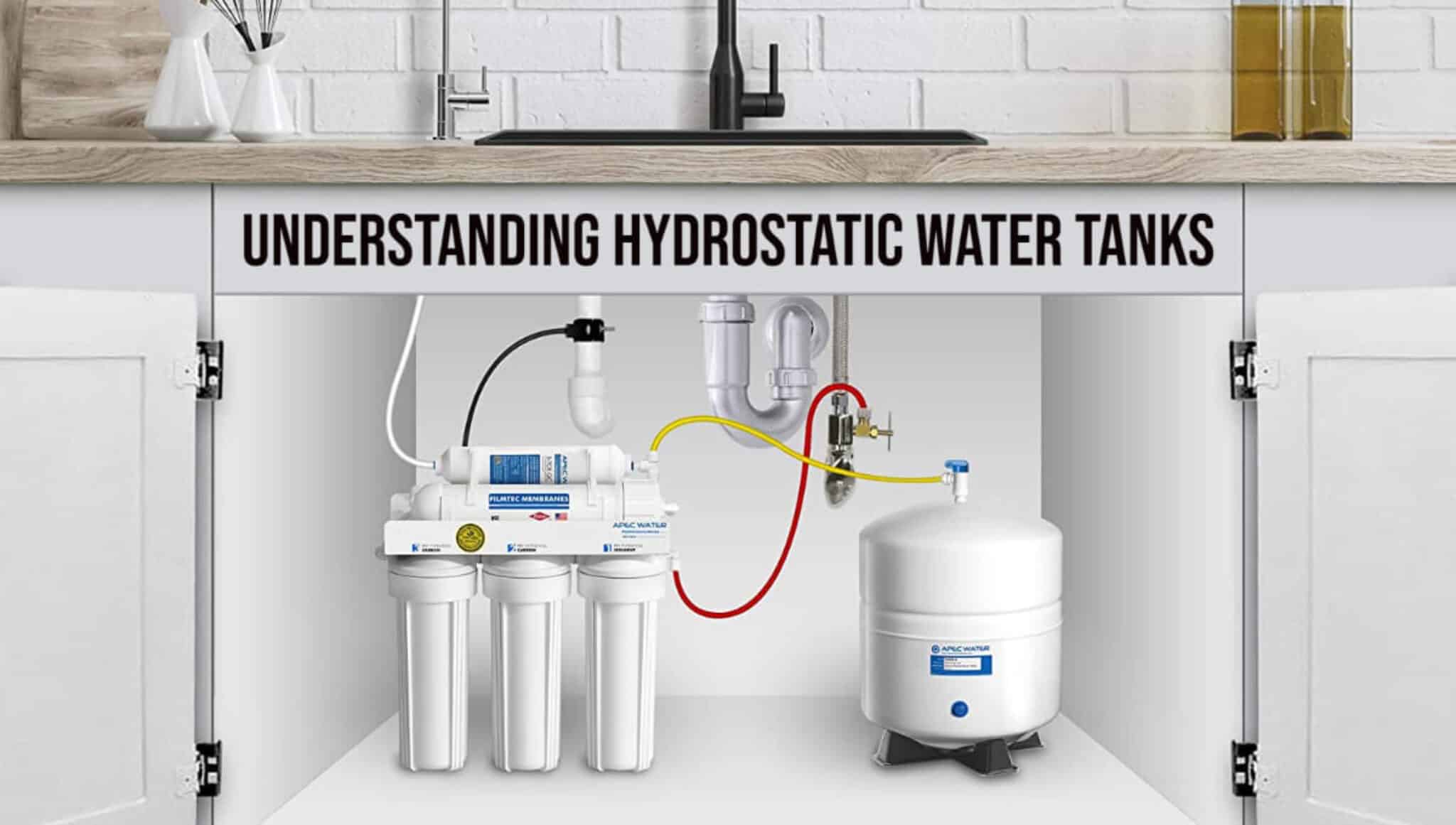
Hydrostatic water storage tanks are unique storage tanks used in under-sink RO water purifiers.
But what exactly is a hydrostatic water storage tank, and how does it work?
In this blog post, you’ll dive deep into the basics of hydrostatic or hydropneumatic water storage tanks and how they operate and explore some of the benefits of using this type of water storage solution in water purifiers.
Whether you’re looking to buy a new under-sink water purifier or currently own one, this post will provide valuable insights and information on hydrostatic water storage tanks.
What is a Hydrostatic Water Tank?
As stated above, hydrostatic water tanks are commonly used in under-sink water purification systems. That’s why they are generally referred to as under-sink RO tanks.
These tanks are typically made of stainless steel or any other corrosion-resistant material and are equipped with a bladder that separates the water from the air inside the tank. The pressurized air in the tank helps to push the water out of the tank and to the faucet.
You’ll see how exactly these under-sink RO tanks work in the following section of the post.
One of the main advantages of using a hydrostatic water tank in a water purification system is that it allows for a consistent flow of purified water.
In addition to holding purified water, hydrostatic water tanks also have other features, such as an air valve for repressurizing the tank. These features help to ensure the safety and reliability of your under-sink RO system.
Generally, these storage tanks come in cylindrical shapes. However, they come in varying capacities and sizes. The size of the tank depends on its storage capacity.
How Do Hydrostatic Water Storage Tanks Work?
Hydrostatic water tanks use air pressure to supply purified water stored in the tank to the faucet above your sink.
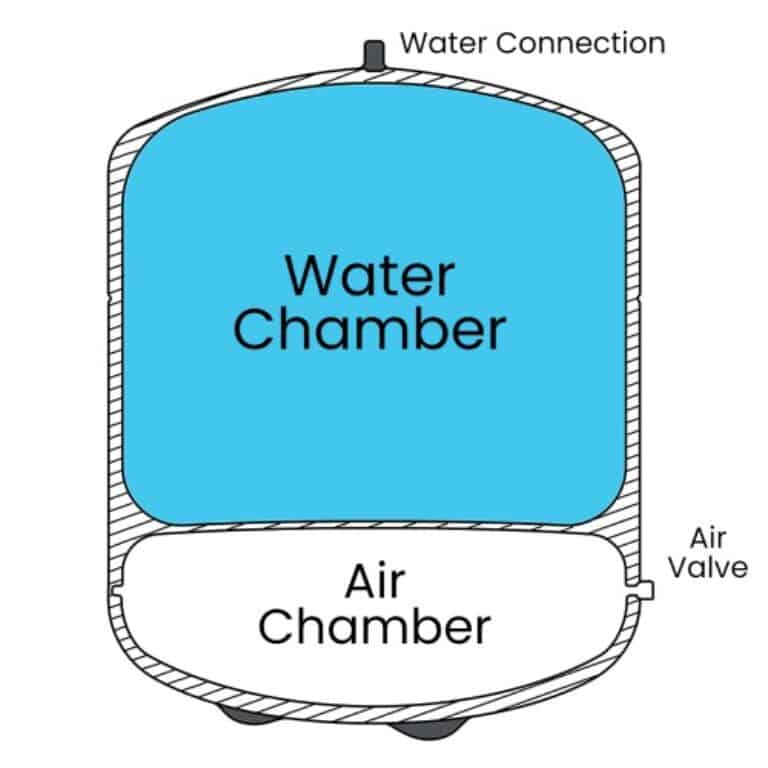
Hydrostatic tanks have two separate chambers, an air chamber and a water chamber, divided in the center by a bladder or diaphragm.
As the storage tank fills with purified water, the weight of the water pushes this bladder down into the air chamber and compresses that air.
As that air compresses, it increases the pressure inside the tank. This pressure pushes the purified water out of the tank and to your faucet.
Without this air chamber, the tank would fill up, but the water would not reach the faucet. Or we’ll have to install a pressure pump, in which case the water would not come out in absence of electricity.
Hydrostatic water storage tanks provide you with purified water without needing any electricity or a pressure pump.
On the smaller tanks, the water is on the top and the air chamber is on the bottom.
Bigger tanks, on the other hand, have water at the bottom and an air chamber at the top. This is so because of the excessive weight of water.
The tank is equipped with a float valve that helps to maintain the proper water level in the tank. The float valve works by opening and closing the water flow into the tank as the water level in the tank rises and falls.
Did You Know?
Hydrostatic water tanks do not store as much water as claimed.
Yes, that’s true.
The mentioned storage capacity is the total volume of the under-sink storage tank.
But as you have seen above, hydrostatic water tanks have an air chamber.
So,
Tank’s actual water storage capacity= Total Tank Volume – Volume of the Air Chamber
Roughly speaking, an 8 liters storage tank, may only hold around 5 liters of water.
Common Issues with Under-Sink RO Water Tanks and Their Solutions
Why there is No or Very Little Water Coming Out of the Faucet?
There can be two reasons behind this problem –
i) The RO system is not working fine because of which it is producing very little or no purified water.
ii) The hydrostatic tank is not working as it should
But how do you find that?
Finding the problem with your RO system is quite easy. All you have to do is, check the output of water by disconnecting the pipe that goes from the last filter to the storage tank. If there is no flow or water is coming drop by drop, then the issue is with your RO system. Call the service engineer.
If the water output is normal, then it is the hydrostatic tank that is creating the problem.
Over a period of time, the air will naturally leak out from the air chamber, resulting in lower pressure inside the tank. This will reduce the flow of purified water from the faucet.
This is a natural phenomenon, and all tanks will face this issue over time.
How Do You Increase the Air Pressure of the Hydrostatic Tank?
All hydrostatic water tanks feature an air valve, just like the one on your bicycle tyre. And you can fill the air in the tank just like you would inflate your bicycle tyre.
Here is how you do it.
Before you start adding air to the tank, switch off your RO system and open the faucet and run the water until the tank is empty.
Leave the faucet open.
Now remove the cap on the air valve and connect the bicycle pump to the valve. Slowly pump air into the tank. You will notice some water coming out of the faucet.
Close the faucet when the tank is completely empty. Now slowly add air into the tank and check the air pressure with a pressure gauge.
The pressure should be around 7 psi. This is the recommended air pressure for most under-sink purifier tanks.
Please note that the air pressure should not be more than 7 psi.
When Do You Need to Replace Your Hydrostatic Tank?
Hydrostatic tanks used in under-sink RO purifiers are made to last for a very long duration. Most tanks last for as long as 10 years or even more.
But like all equipment, they too can develop problems over time.
If the RO system is working fine but the faucet does not dispense any water even after adding back the air pressure in the tank, then it is a clear sign that the tank needs to be replaced.
Also, if you notice water leaking from the air valve when you refill the air or test the pressure, that is also a clear sign that the bladder separating the water and air chamber within the tank has failed. This cannot be repaired, and you will have to replace the tank.
Do You Need to Clean Under-Sink RO Tanks?
Yes, like all wall-mounted RO purifiers, the hydrostatic tank of your under-sink water purifier also needs to be cleaned.
And you must at least clean the RO tank every 6-12 months. This will clean all the slime that builds up over time and ensures the purity and safety of the water you drink.
Wrapping Up
In conclusion, the ability of hydrostatic tanks to use air pressure to maintain a constant water flow makes them a valuable addition to all under-sink water purifiers. Hydrostatic tanks are as important a part of under-sink water purifiers as an RO membrane.
Hope this post has provided you with all the information about hydrostatic water tanks.
If you have any specific query that is not answered above, please leave a comment below and we’ll be happy to revert back in the next 24 hours.
In a country like ours, where water shortage is a major problem, there can be no justification for such wastage.
Taking note of the unnecessary use of RO purifiers, the National Green Tribunal (NGT) passed an order, in December 2021, banning the use of RO purifiers in areas where the TDS level is below 500 ppm. The NGT further asked the Government of India to make it mandatory to recover more than 60% of water wherever RO is permitted in the country.
Our View
Reverse Osmosis or RO purification is not bad. There is no study, but this effective water purification technology must have saved millions, from waterborne diseases, across the globe.
RO purification is considered the most effective and safest form of home water purification.
The problem is not the technology but its unnecessary use.
Due to a lack of consumer awareness, RO has become the default water purification choice.
But the truth is, that most Indian homes do not need RO purification. Especially the ones where the source of water is municipal water supply.
Before the official ban, the NGT, in its order dated May 20, 2019, requested the Ministry of Environment and Forests to not only frame rules for the manufacturing and sale of RO purifiers but also to ban RO use in areas with low TDS levels.
Understanding the gravity of the situation and the impact of the formal ban on their businesses, many brands started working on addressing the problem.
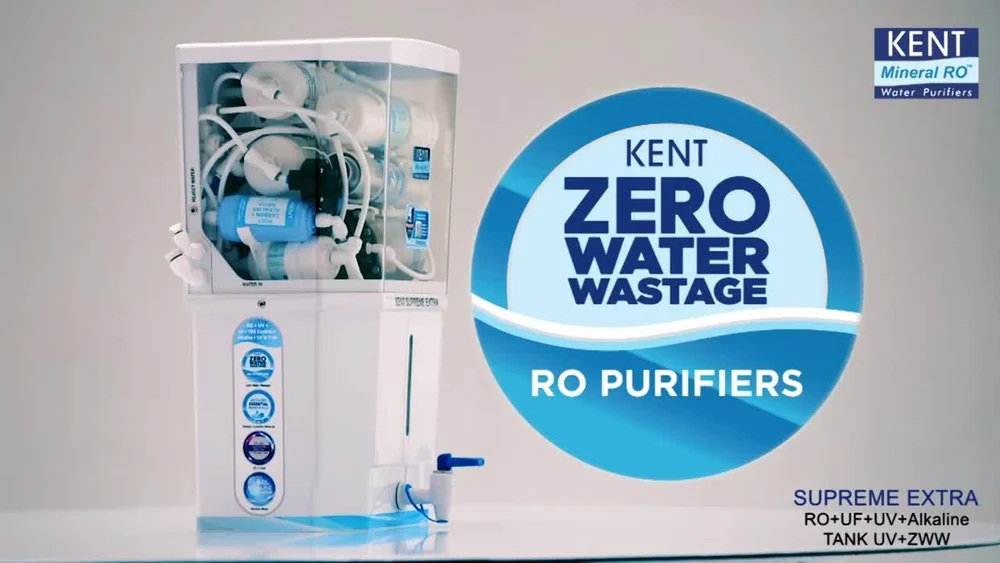
Kent’s zero water wastage technology simply provides you with an easy and automated way to reuse the RO reject water by pushing it back to the overhead tank (Pani ki tanki).
How Kent’s Zero Water Wastage Technology Works
If you have used an RO purifier before then you are already aware that all RO purifiers have a separate pipe for waste or reject water.
In most cases, this wastewater goes down the drain and is wasted.
To find a solution to this problem, Kent came up with an innovative idea.
To save the RO waste water, Kent added an additional pump in their RO purifiers.
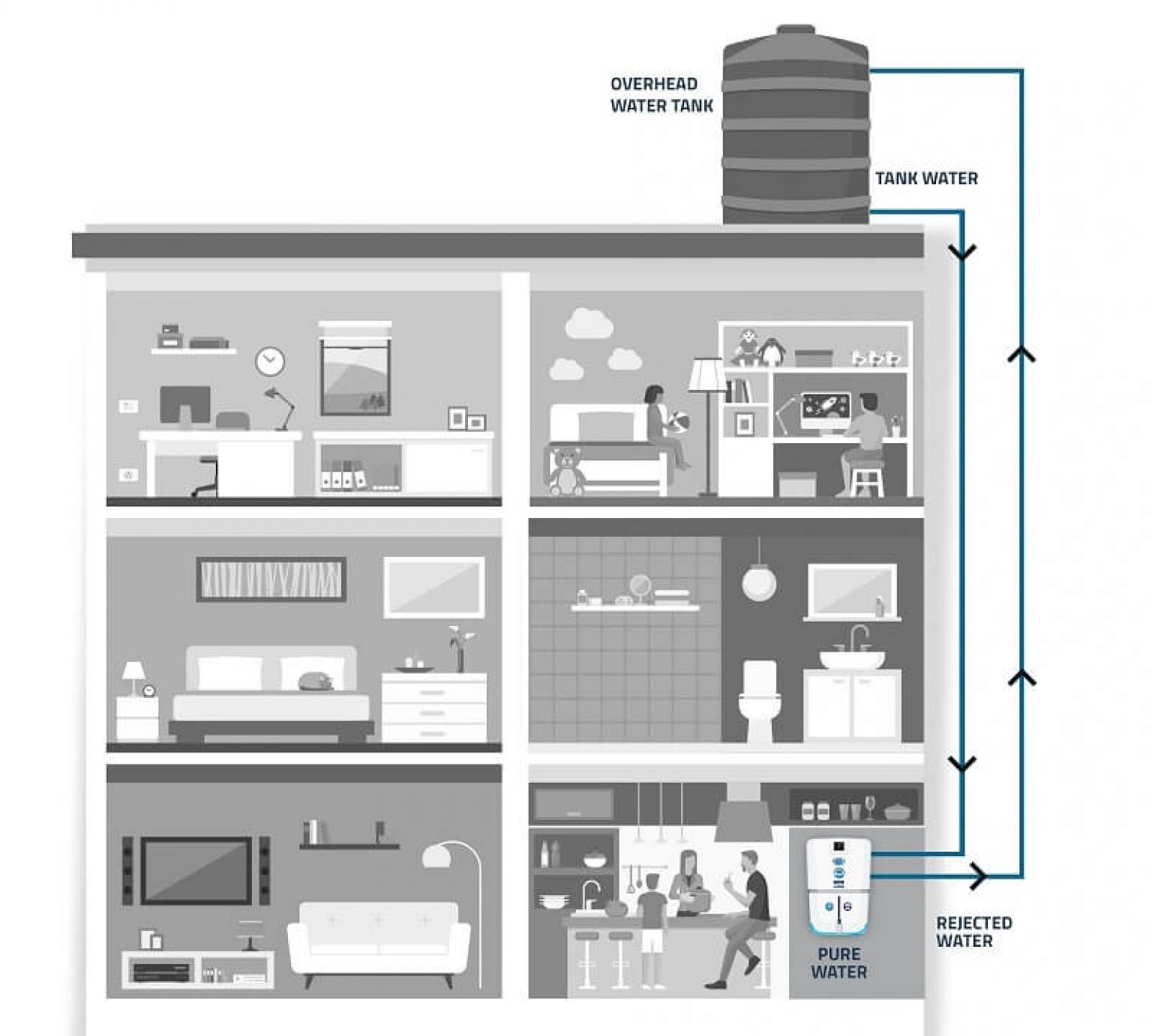
This pump sends back the rejected water to the overhead water tank. Instead of sending the reject water down the drain, it gets mixed with water in the overhead tank. This water is reused as normal water for household purposes.
This ensures not a single drop of water is wasted.
Take a look at the image given below for a better understanding of the process.
Zero Water Wastage Process
The internal pump might seem small but it is highly powerful. It can push the wastewater to a height of up to 10 stories.
This technology might not be that practical if you are living in a multi-story apartment building, because such buildings generally have one large common tank. In most cases, for various reasons, you don’t have permission to push the RO reject water back into the tank.
However, this technology will prove very beneficial if you are living in an independent house that has its own overhead water tank.
Myths About Zero Water Wastage Technology
It will increase the TDS level of water in the overhead tank?
No, it won’t.
Depending on the size/capacity of your overhead tank and your daily drinking water requirement, the RO purifier normally uses just 3-7% of the water in your overhead tank.
This means that the RO reject water that goes back to the overhead tank is just 2-5% of the total water in the overhead tank.
The RO reject water gets mixed with overhead tank water. And since the overhead tank gets fresh water supply daily, you won’t notice any significant increase in the TDS level of the overhead tank water.
The RO reject water is much better in quality as compared to the raw water supplied to your home. This is so because the rejected water has already passed through multiple filtration stages like pre-filter, sediment filter, and pre-carbon filter. This means the rejected water is free from all the dust, mud, sand, and chlorine.
It will reduce the life and efficiency of the membrane and filters.
As we have seen above, the zero water wastage technology does not have any significant adverse impact on the quality of water in the overhead tank.
The overhead tank water gets a fresh water supply every day so there will be no negative effect on the life of the membrane and filters of the RO purifiers.
Some Zero Water Wastage RO Purifiers from Kent
KENT Supreme Extra
Kent Grand Plus
Kent Prime Plus
Can this Technology be Used in Existing Kent ROs?
Yes, that’s the best part. To make use of this environment-friendly technology, you don’t need to buy a new Kent RO. Kent offers an upgrade kit using which you can turn your existing RO purifier to ‘Zero Water Wastage’ RO.
Saves Water & Your Money
Bonus Tip
How to Achieve Zero Water Wastage in any RO?
You can achieve zero water wastage with all RO purifiers. You don’t necessarily have to buy a new Kent RO for that.
However, Kent’s new technology makes the process automated and a lot easier.
To achieve zero water wastage, you need to follow two easy steps.
Store – Instead of sending the RO reject water down the drain, store it in a separate storage tank for other uses.
Re-use – Use this stored water for washing utensils, floor mopping, gardening, cleaning & flushing your toilet, etc. You may want to read our detailed post on reusing RO-reject water.
Clean Drinking water is not just a nation-specific concern but a pressing global issue today. Scientific studies have suggested that climate change has enormously impacted our environment. As a result, our water bodies and other drinking water sources are either badly hit or terribly polluted. So, we need effective water purification systems that can work constantly to give clean drinking water.
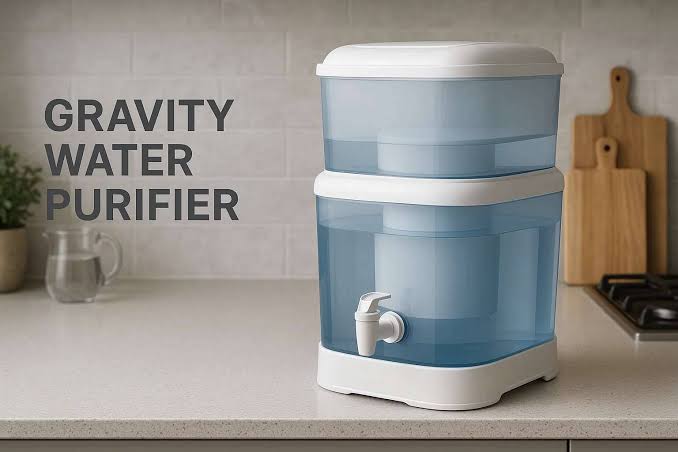
What is Gravity-Based Water Purification?
In this process of purification, water is allowed to flow from a top container to a lower container under the effect of gravity. Gravity-based water purifiers do not use electricity and are therefore sometimes called offline or non-electrical water purifiers. They typically use activated carbon or UF, which is made up of small carbon granules in order to absorb impurities from the water. The UF acts like a membrane of hollow fibers in which impurities stick.
How Do Gravity-Based Water Purifiers Work?
The gravity-based water purifiers basically consist of three filters:
Microfiber mesh or Pre-filter: This filter is attached to the uppermost tank and when water is allowed to pass through this, larger particles like sand, dust, mud, etc. get removed.
Activated carbon filter: This stage is a crucial one in which more minute particles, invisible impurities, and chemical contaminants are effectively removed. It also reduces bad odors and colors from the water. It also removes parasites and pesticides.
Polisher or Post-carbon filter: Its basic aim is to re-filter the purified water to make it crystal clear.
When to Use a Gravity-Based Water Purifier?
Gravity-based water purifiers are recommended for municipal tap water supply that does not have harmful heavy metals like lead and arsenic.
Since they do not require electricity to operate, so should be used in areas where power cuts are frequent.
Work without running water, are best suited for areas where running water is not available.
These are recommended for TDS levels of up to 500 ppm.
Clean and safe drinking water is the basic necessity and ensuring its availability is one of the prime responsibilities of concerned authorities. However, in countries like India, providing clean and safe drinking water to every household remains a big challenge for the Government organizations even today. Polluted and unsafe water is one of the most prominent reasons for common illnesses to life-threatening diseases like Cholera, Diarrhea and Hepatitis.
he best way to fight against water-borne diseases is to drink pure and safe water. Using a RO+UF water purifier is one way you can provide advanced protection to your family.
There are plenty of options, from all the leading water purifier brands, which provide water purification using RO+UF technology.
What is RO+UF Water Purifier?
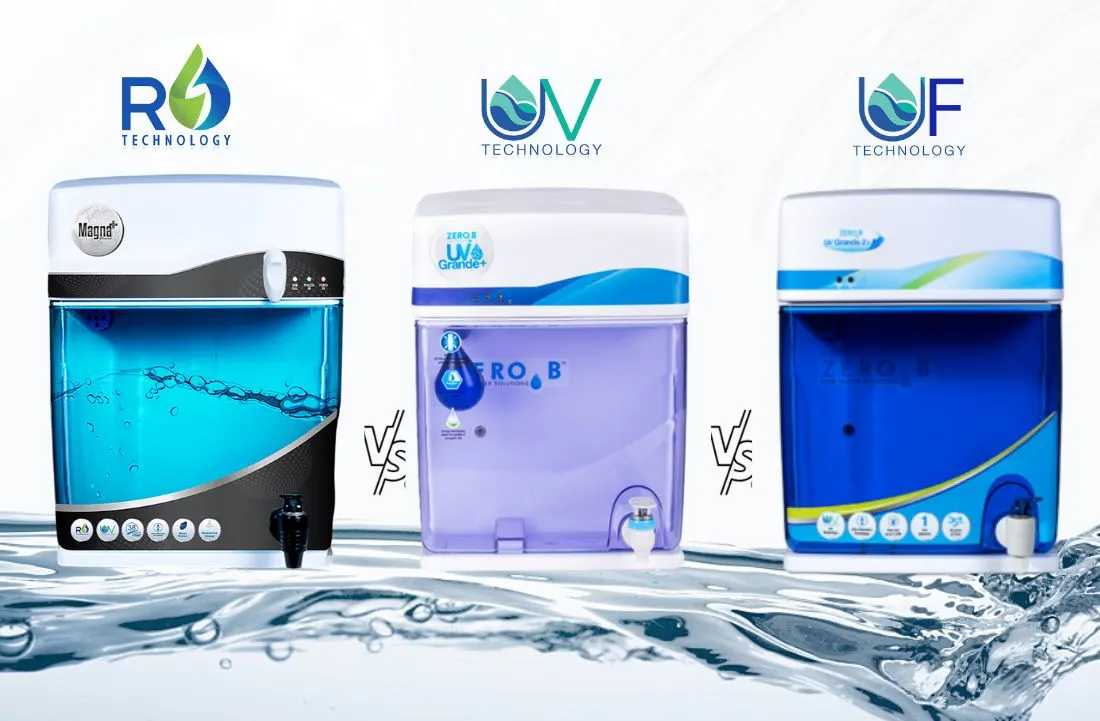
A RO+UF water purifier employs both Reverse Osmosis and Ultrafiltration methods of purification. The RO technology is responsible for removing larger particles, dissolved solids and heavy metals from the inlet water; whereas the UF technology is used to eliminate much finer and minute impurities as well as disease-causing bacteria and viruses.
How Does RO+UF Water Purifier Work?
RO technology basically uses a semi-permeable membrane in order to purify water. The Reverse Osmosis carries out a multi-stage filtration by combining particle filtration and active carbon. Since, RO membrane needs to be protected from larger particles and sediments, so a pre-filtration cartridge is used which acts as sediment filter or carbon block filter. It prevents damage to the RO membrane by stopping excess exposure to too much chlorine found in the municipal water. Then the reverse osmosis membrane is used in which a pump is used to n optimum pressure is applied and as a result, only water molecules are allowed to pass through it, while blocking the impurities.
In the second stage, Ultrafiltration technology is used which is a technique of separating remaining impurities with high molecular weight. UF is a clean and simple technology that doesn’t change the chemical properties of water and doesn’t add any odour or colour.
The UF technology uses a semi-permeable membrane whose pore size ranges from 0.005 to 0.01 micron. It can effectively filter all kinds of germs and microorganisms from the water.
The only difference between RO and UF membranes is UF technology can be used without electricity and it doesn’t completely purify dissolved salts.
When to use RO+UF Water Purifier?
The RO+UF water purifiers are recommended for water that has high levels of TDS up to 2000ppm.
For increased biological impurities like bacteria, virus, cyst etc.
For water supply from the municipality, bore well, and tankers.
For a high degree of dissolved salts, solid impurities, organic chemicals, pesticides, and heavy metals.
What is the first word that comes to your mind when you think of water purification or water purifiers?
I am not that good at reading minds but I think I have read your mind pretty well.
Didn’t you just think of ‘RO’?
Yes?
See, apart from reviewing water purifiers, I can now try my hands on mind reading.
Well, jokes apart.
I didn’t get this one right because of my sharp mind-reading skills.
I got it right because I have years of experience and a fair understanding of the water purification market and consumer preferences.
Reverse Osmosis (RO) has become as synonymous with water purification as Colgate is to toothpaste and Baba Ramdev is to Yoga.
Reverse Osmosis water purifiers have become so popular in India that you hear people referring to every home water purifier as ‘RO’ and purified water as ‘RO water’.
But, do you know what Reverse Osmosis technology is and how it works?
Should you blindly buy an RO purifier?
Worry not!
This article will answer all your queries in simple terms.
You’ll have a much better understanding of Reverse Osmosis technology by the time you reach the end of this article.
That’s a GUARANTEE!
What is Reverse Osmosis?
Reverse Osmosis is one of the most effective water purification technologies. It gives you clean, pure, and safe water that tastes great.
Reverse osmosis (RO) is a water purification process that uses a semi-permeable membrane to filter out dissolved solids, microorganisms, and larger particles from drinking water.
Did that sound too technical?
Let’s make it easy to understand.
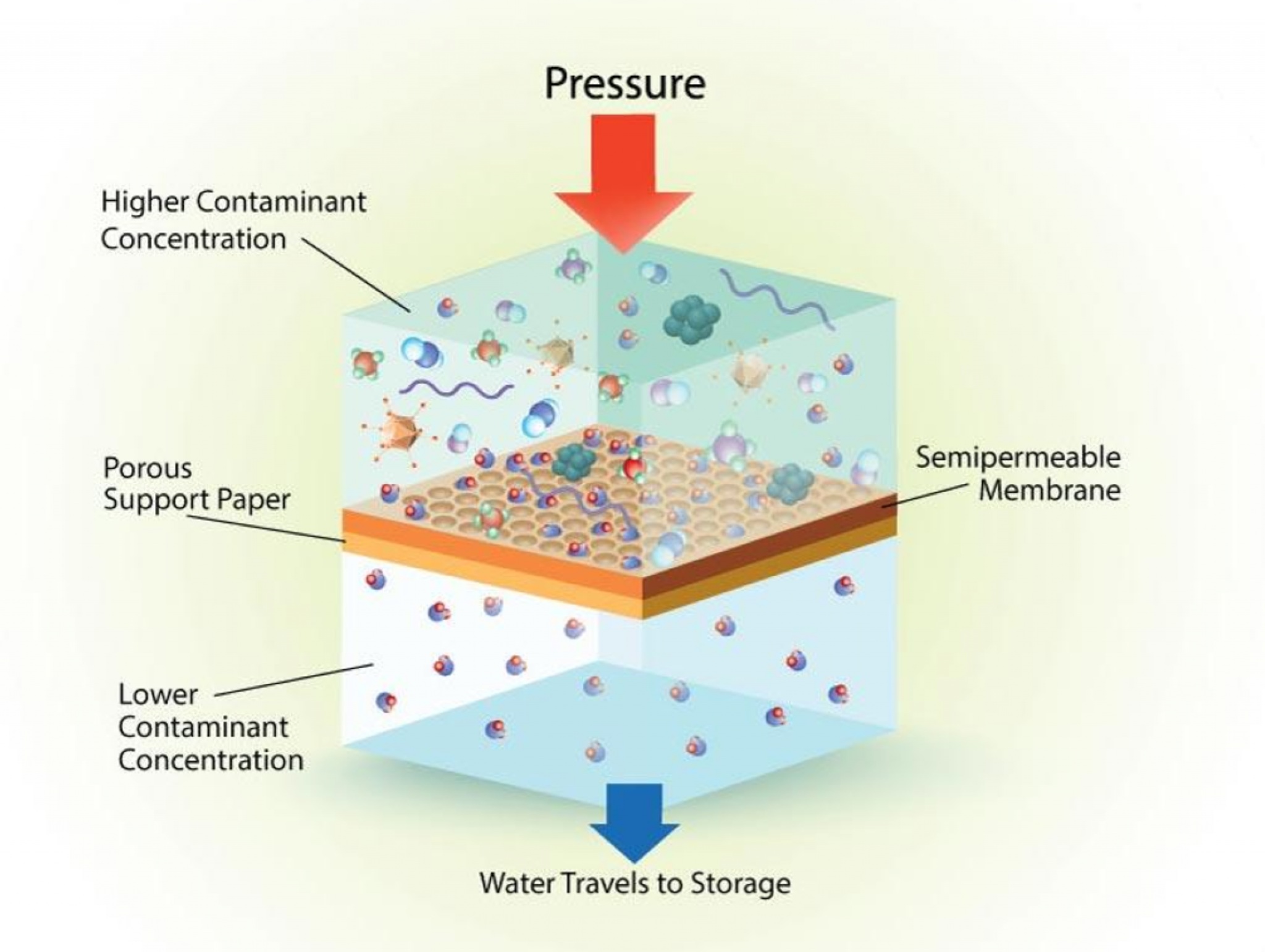
In reverse osmosis, water is pushed through a semi-permeable membrane (RO membrane) that allows only water molecules to pass through and filters out everything else.
What is Semi-Permeable Membrane?
A semipermeable or selectively permeable membrane is a layer (or group of layers) that allows only certain molecules to pass through it but not others.
How Does Reverse Osmosis Work?
Before I throw any light on how reverse osmosis technology works.
Let’s first understand the process of osmosis.
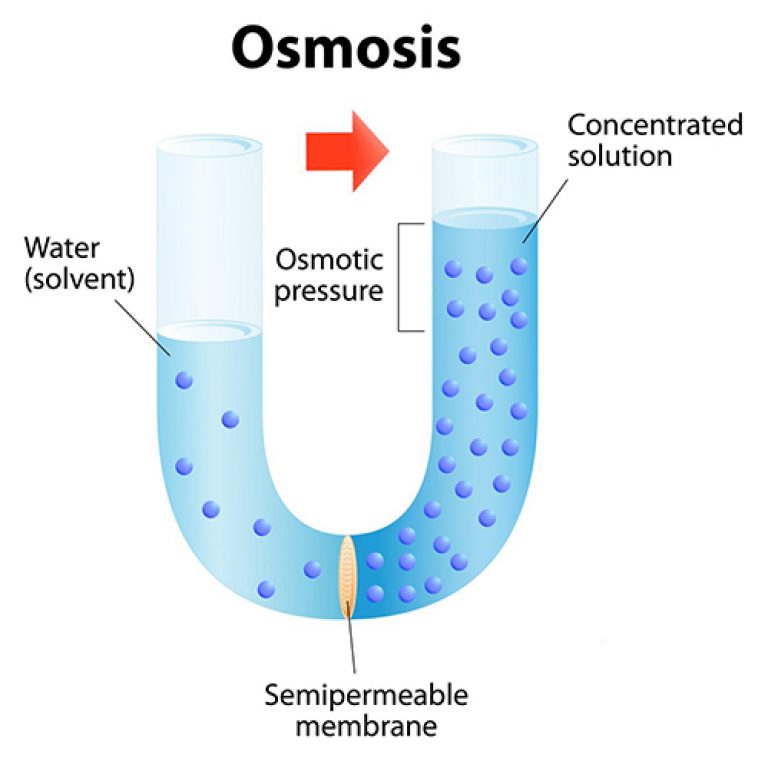
Osmosis is basically the passage of water molecules through a semi-permeable membrane that blocks particles and dissolved solids present in the water. The water moves from a low concentration area to a high concentration area passing through a barrier due to the surrounding osmotic pressure.
Osmotic Pressure
The natural pressure due to which any slightly concentrated solution moves through a semi-permeable membrane towards a highly concentrated solution.
In other words, under osmosis, if you put highly contaminated water and less contaminated water on either side of a semi-permeable membrane then less contaminated water (low concentration area) will pass through the membrane and move towards highly contaminated water (high concentration area).
Take a look at the image given below. This explains the process of osmosis quite easily.
It is quite clear that osmosis in its standard form can’t be used for water purification.
Why would you take less contaminated water, filter it, and then mix it with highly contaminated water?
What if you reverse this process?
Take highly contaminated water, filter it, and then mix it with pure or less contaminated water.
Now you are starting to think in the right direction.
Wait!
What happens to the osmotic pressure then?
This villain will never let that happen.
You’ll have to find a hero that knocks out this villain.
That hero has to have more powers, pressure in this case.
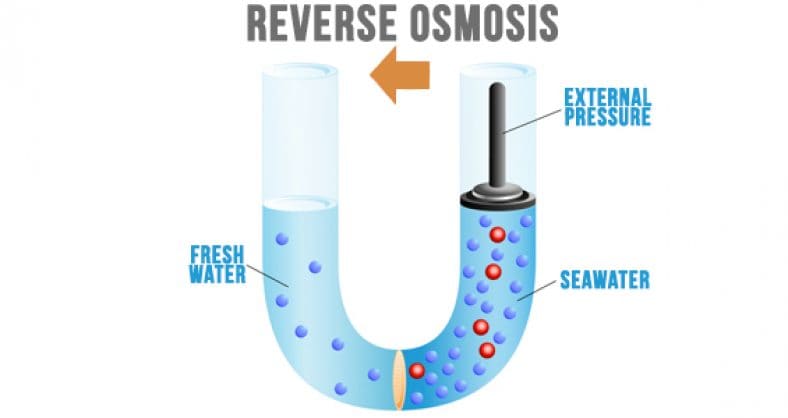
That hero is an external pressure that is much stronger than the natural osmotic pressure.
There you are.
Under high pressure, the osmosis process gets reversed i.e. the solution now flows through a semi-permeable membrane from high concentration to low concentration.
This is reverse osmosis in most simple terms.
The image given below explains the process of reverse osmosis so beautifully.
The semi-permeable membrane used in reverse osmosis purification has hundreds or thousands of pores as small as .0001 microns.
These minute pores only allow water molecules to pass through and filter out everything else.
That’s why RO purification is considered the most reliable water purification technology.
Confused about different purification technologies like RO, UV, UF, and MF? Read this article for a complete understanding of how they work.
History of Reverse Osmosis
Before I spill the beans.
Can you guess when was reverse osmosis invented?
The mid-1950s.
Yes, you read that right.
It might look like one of the latest technologies.
But the truth is, that researchers from the University of California and the University of Florida successfully used reverse osmosis to produce fresh water from seawater in the mid-1950s.
In 1977, the municipal corporation of Cape Coral, Florida, first used reverse osmosis on a large scale for public water distribution.
Advantages of Reverse Osmosis
Reverse Osmosis is the most reliable form of water purification. It is the only water purification technology that filters out such a broad range of contaminants ranging from dust particles, chlorine, microorganisms, and harmful chemicals, to dissolved solids and heavy metals.
Reverse Osmosis is the only home water purification technology that turns high TDS, salty, and hard water into soft, sweet-tasting water.
Protects you from infections and waterborne diseases.
RO purified water is the best alternative to costly bottled water.
RO purification is a fully automated process. All you have to do is just turn the system, everything else is taken care of by the purifier.
RO purification results in huge water wastage. Traditional RO systems can waste as much as 3 glasses of water for every glass of purified water they produce.
Both, the initial cost and the maintenance costs are high.
The process is quite slow, even the most efficient home RO systems can hardly provide 20-25 litres of purified water per hour. Most RO systems available in India produce around 10-12 litres of purified drinking water per hour. But that’s more than sufficient for most homes.
Requires periodic replacement of filters and membrane, you can’t fit and forget.
Does not disinfect water. RO purification can remove some bacteria but it should not be relied upon to remove 100% of bacteria and viruses
What Contaminants Does Reverse Osmosis Remove?
I think that’s the wrong question to ask.
The question that should be asked is ‘What contaminants do reverse osmosis not remove?’
What all does the reverse osmosis system remove…
Dissolved solids like Calcium, Magnesium? Yes.
Salt? Yes.
Dust, Dirt, and Sediment? Yes.
Chlorine? Yes.
Heavy metals like Lead & Arsenic? Yes.
Herbicides and pesticides? Yes.
Bacteria and Viruses? No. Reverse osmosis may remove some bacteria, but RO purification does not provide 100% safety against microbial contamination from bacteria and viruses. For removing microorganisms like bacteria and viruses, UV disinfection is recommended. That’s why most RO purifiers also feature a UV purification stage.
Do Reverse Osmosis Systems Waste Water?
All reverse osmosis systems produce two types of water. The first is the purified water that is stored in the purifier tank for drinking, and the second is the rejected water that is discarded.
The wastewater or rejected water carries all the contaminants removed during reverse osmosis purification.
Generally, you view this as unnecessary waste.
Right?
I also used to think that way until recently.
When I read an interesting view from one of the leading water purification experts in the USA.
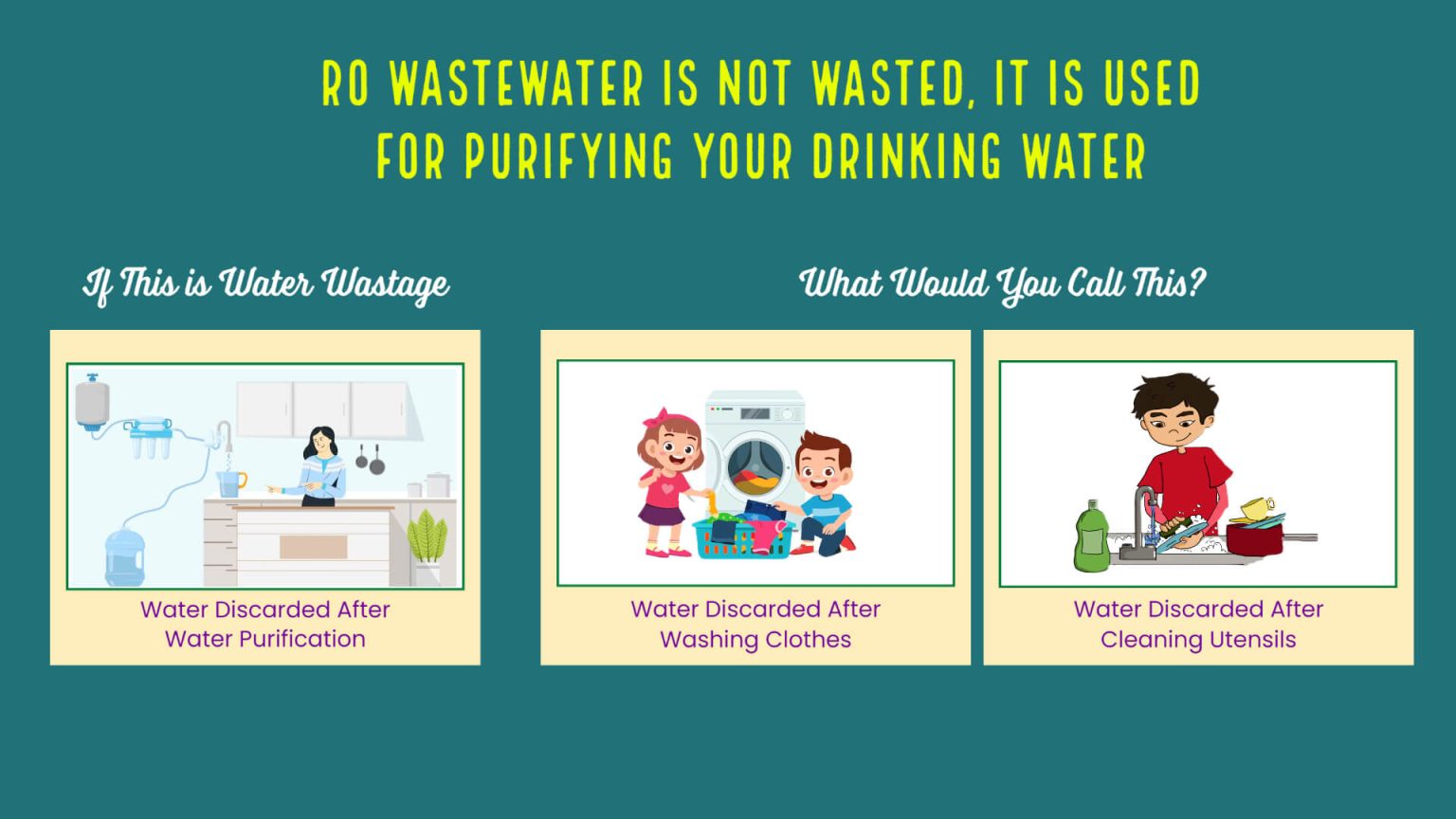
He said ‘The wastewater is not being wasted without any cause. This wastewater is used for a purpose. The wastewater in an RO system is being used for purifying your drinking water.’
Would you call the water that is thrown out by your washing machine after cleaning your clothes wastewater?
What would you call the water that goes down the drain after bathing or washing utensils?
Most definitely, your answer would be ‘this water is not wasted but used for cleaning’.
Right.
In the same way, the water that comes out of an RO system is used for cleaning/purifying your drinking water.
Seems logical to me.
What do you think about this thought? Do let us know in the comments section.
Still, it’s our moral responsibility to not only use efficient RO systems that save more water but also to reuse RO wastewater for other tasks.
Is Reverse Osmosis Water Bad for You?
Critics of RO purifiers often project them as villains. And all of them have two arguments in support of their claims.
Wastage of water
Demineralization of water
We have discussed the first argument just above.
Now coming to the second claim.
There is absolutely no doubt that, along with all the harmful contaminants, a reverse osmosis system also removes essential minerals like calcium and magnesium.
That’s because an RO membrane can’t differentiate between good contaminants and bad contaminants.
But does that make RO water bad?
There is no doubt that your body needs essential minerals.
But water is not the primary source of these minerals. The primary source of these minerals is food, fruits, and green vegetables.
If water was the primary source, you would have to drink too much water to meet the recommended dietary allowance: Calcium: 1000 mg/day, Magnesium: 400 -420 mg/day (approximate values).
Drinking water with some essential minerals is acceptable, but the Bureau of Indian Standards (BIS) recommends that the ideal TDS level of drinking water should not be more than 500 PPM. Unfortunately, a large part of India, especially those that depend on groundwater for drinking, has TDS levels above 500 PPM.
Reverse Osmosis water is also good for your kidneys and is recommended for people with Kidney disorders like stones etc.
This leaves RO purification as the only alternative for the purification of water.
Cutting the long story short.
Reverse Osmosis does remove minerals, but this should not be the cause of your worries as we have just seen right above.
But, always remember, we do not recommend blindly buying an RO purifier.
If you would like to learn more about which water purifier to buy, please read this informative post.
Wrapping Up
Like with all things in life, reverse osmosis, does have a few limitations.
But the benefits of reverse osmosis far outweigh these small limitations.
And it is high time, that some people stop projecting this life-saving water purification technology as a villain all the time.
I hope this post has cleared many of your doubts and questions about reverse osmosis. If you still have any queries, please feel free to leave a comment below and we’ll try to answer in 24 hours.
When it comes to choosing a water purifier for your home, there are many factors to consider, including the type of purifier, the size of the unit, and the installation location.
Two popular options are under-sink water purifiers and wall-mounted water purifiers, each with its own set of benefits and drawbacks.
In this blog post, we will compare under-sink and wall-mounted water purifiers to help you decide which is the best option for your needs.
Under-Sink Water Purifiers
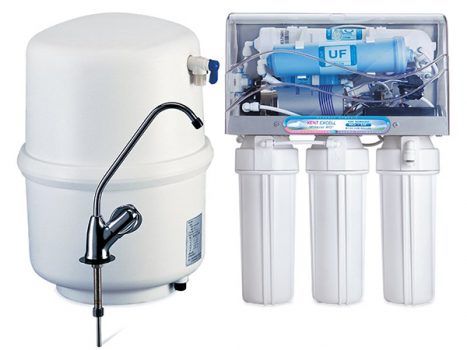
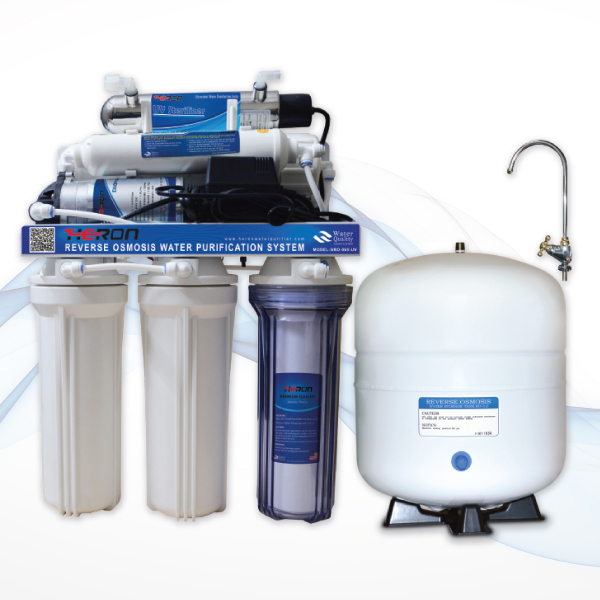
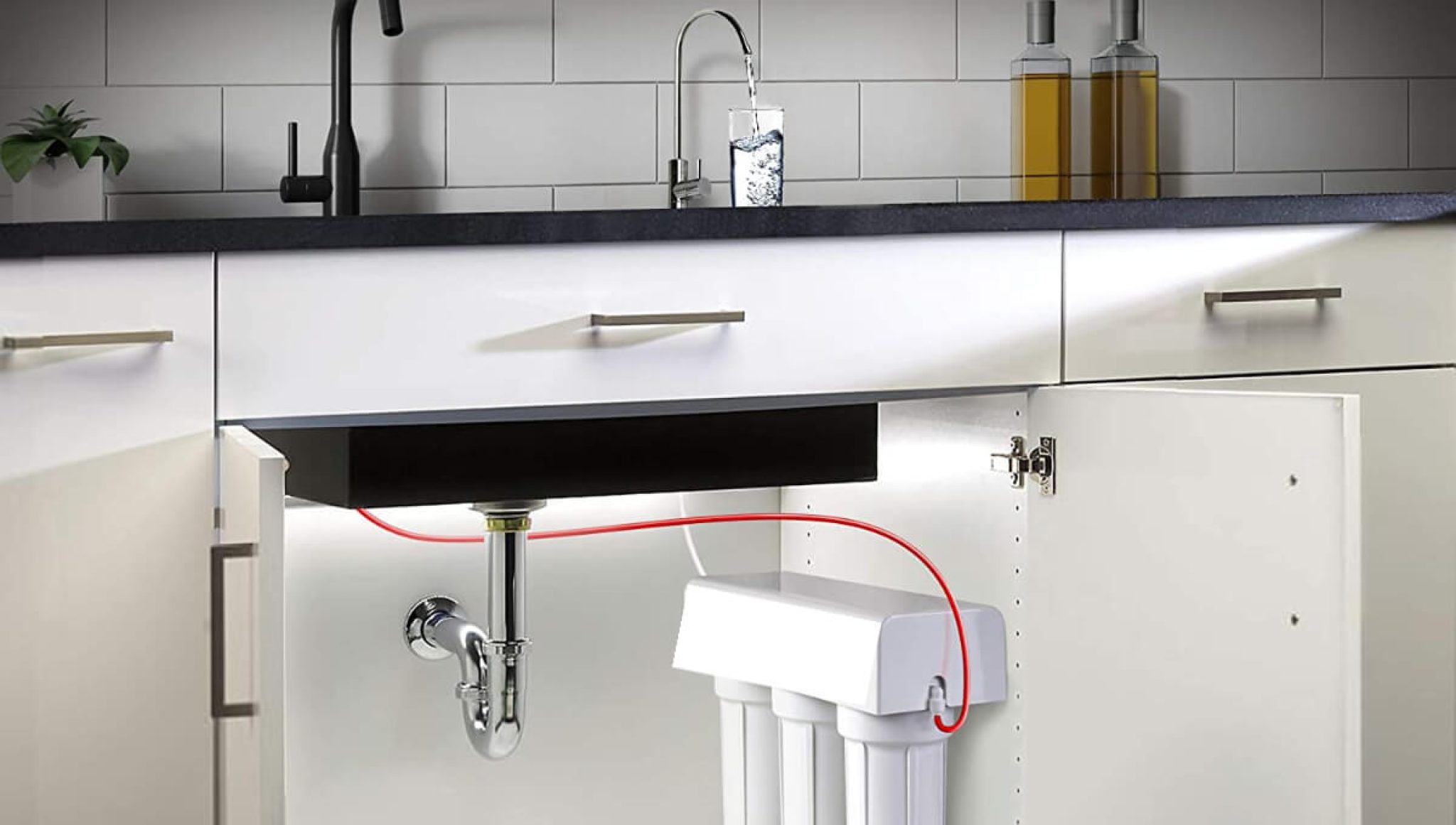
Under-sink water purifiers are installed directly under the kitchen sink and are connected to the home’s water supply. These units are usually small and compact, making them a good choice for homes with limited space. They are also relatively easy to install, as they do not require any major plumbing work.
One of the main benefits of under-sink water purifiers is that they are out of sight and out of the way. This makes them a good choice for people who want to keep their kitchen walls or countertops clutter-free.
Another advantage is that under-sink purifiers do not take up any wall space, which is especially useful in small kitchens or homes with limited wall space.
However, there are also a few drawbacks to under-sink water purifiers. One issue is that they can be difficult to access for maintenance and repairs. This means that if you need to replace a filter or perform any other maintenance on the unit, you may need to crawl under the sink or hire a professional to do it for you. Additionally, under-sink water purifiers can be prone to leaks if they are not installed correctly.
Under-sink purifiers are comparatively costlier and you have very limited options to choose from. An under-sink RO+UV purifier would cost you over Rs. 15,000 while you can buy a wall-mounted RO+UV purifier for just Rs. 8,000.
Under-sink water purifiers are very popular in the U.S. and Europe, but not many people in India prefer these purifiers.
Wall Mounted Water Purifiers
Wall-mounted water purifiers are mounted on the wall, usually near the kitchen sink or in any other convenient location. These units are larger and more visible than under-sink purifiers. In most cases, a wall-mounted water purifier can also be kept on a tabletop or your kitchen counter.
One of the main benefits of wall-mounted water purifiers is that they are easy to access for maintenance and repairs. This means that you can easily change the filters or perform other maintenance tasks without crawling under the sink or hiring a professional. Wall-mounted purifiers are also less prone to leaks, as they are not connected to the home’s water supply in the same way as under-sink units.
Wall-mounted purifiers are not only much cheaper than under-sink purifiers but they are also a lot easier to maintain.
However, there are also a few drawbacks to wall-mounted water purifiers. One issue is that they are more visible and take up wall space, which may not be ideal for people who want to keep their kitchen walls clutter-free.
Which is Right for You?
Ultimately, the choice between an under-sink and a wall-mounted water purifier will depend on your specific needs and preferences. If you have limited space in your kitchen or want to keep your countertops clutter-free, an under-sink purifier may be the better choice.
However, if you want easy access to the unit for maintenance and repairs, or if you prefer a more visible and prominent installation, a wall-mounted purifier may be the way to go.
OUR VIEW
We recommend going for a wall-mounted water purifier as they are more affordable and easier to maintain. You also have a wide range to choose from.
You should go for an under-sink water purifier only if you are too worried about the water purifiers spoiling the look of your ultra-modern kitchen or if there is not sufficient wall/counter space in your kitchen.
To help you make a decision, consider the following factors:
Space: How much space do you have in your kitchen? If you have a limited counter or wall space, an under-sink purifier may be a better choice. If you have sufficient wall space, a wall-mounted purifier may be a good option.
Maintenance: How important is it to you to be able to easily access the purifier for maintenance and repairs? Wall-mounted purifiers are easier to maintain.
Cost: What is your budget? Both the initial cost and maintenance cost of under-sink purifiers is higher than wall-mounted purifiers.
Take action today and choose a water purifier that best fits your needs and budget. Your health and safety are worth it!
Water purifiers have become an integral part of our lives.
Today I am going to talk about a type of water purifier that is not so common in Indian homes.
Unlike India, under-sink water purifiers are the preferred choice for homes in the U.S. and Europe.
However, these water purifiers are slowly gaining popularity in India too.
The biggest reason for their growing popularity is the fact that kitchens of the most newly constructed homes & apartments have a provision for under-sink purifiers only.
Under-Sink water purifiers do what other water purifiers do, the only difference being the fact that they can be installed below your kitchen sink.
Highly efficient, Under-the-Counter RO systems work hidden and out of sight, making them the best choice for all design perfectionists.
Apart from the looks, the best part is saving up on space. These purifiers don’t encroach onto your much-needed counter space. Instead, they can be fitted neatly below sinks, making your kitchen work space as tidy as can be.
And it’s not like you’re compromising on filtration strength. They perform just as skillfully as any other purifier out there.
All the while adding to the beauty of your Kitchen, two benefits for the price of one!
Now here are some suggestions for you to pick the best-of-the-rest when it comes to the Under-sink RO water purifiers market.
Reviews of the Top 3 Under Sink Water Purifiers in India
The innovator of the industry, AO Smith, never stops surprising. This time with their 6-Stage purification under-sink RO.
This water purifier purifies water using a Pre-filter, Sediment Filter, Pre Carbon Filter, RO Membrane, and SCM-TECH (Silver Activated Post Carbon) + MIN-TECH (Mineraliser Technology).
It’s all the filtration you’d ever need.
Exclusive patented SSM Technology (Side Stream RO Membrane) purifies water with high TDS up to 2000 ppm.
This purifier is also known to waste less water with improved water recovery.
AO Smith Z2+ throws special focus on the best possible removal of suspended solids and sediments. They’ve achieved this with some pretty nifty Advanced Pre-Filters and Sediment Filters.
The MIN-TECH cartridge adds essential minerals (Calcium and Magnesium) to give you purified water with a balanced pH and a great taste.
Giving out a storage capacity of 5 litres and a purification capacity of up to 15 litres per hour.
All this comes with WQA certification for their RO membranes and everything. Maintaining all ANSI 58 and NSF standards.
The Z2+ comes in a very sleek and compact design and easily fits under smallest of kitchen sinks. The storage tank is also placed inside the purifier housing.
This product comes with a gooseneck swivel faucet that gives you complete freedom and convenience.
Unlike other under-the-counter RO purifiers, the Z2+ features a very informative and useful digital display with a full range of indicators and alerts.
Apart from the regular indicators for purification on/off, low water pressure, and tank full, this product gives you advanced alerts when the RO membrane and other filters need to be changed.
The storage tank is provided inside the purifier unit
Balances the pH level and improves the taste of purified water
LED indicators
Negatives:
Price is a little high
A small storage tank of just 5 litres
Not suitable for big families
2. KENT Excell Plus Under Sink RO Water Purifier
7-litres Storage Tank, Filter Change Alarm, 3-Years Free Service AMC
This Kent water purifier utilizes Kent’s patented Mineral RO purification technology to the fullest.
It’s suitable for all kinds of purification with its TDS controller, be it municipal tap, or borewell water. Providing 100% safe water by getting rid of even the finest impurities, such as chemicals, bacteria, viruses, and salts.
The 7-litres storage of the hydrostatic tank is also top of the line. Whereas the purification capacity is 15 litres/hours. All the while utilizing Kent’s ‘double-purification’ of RO/UF + UV.
Kent Excell Plus purifies the input water in 4 different stages to give you clean and safe drinking water.
Sediment Filter
Activated Carbon Filter
RO or UF (depending upon how the TDS controller is set)
The automatic filter change alarm alerts you when filters and membranes are due for replacement. There is a separate alarm that goes off automatically whenever the system detects any fault in the UV lamp.
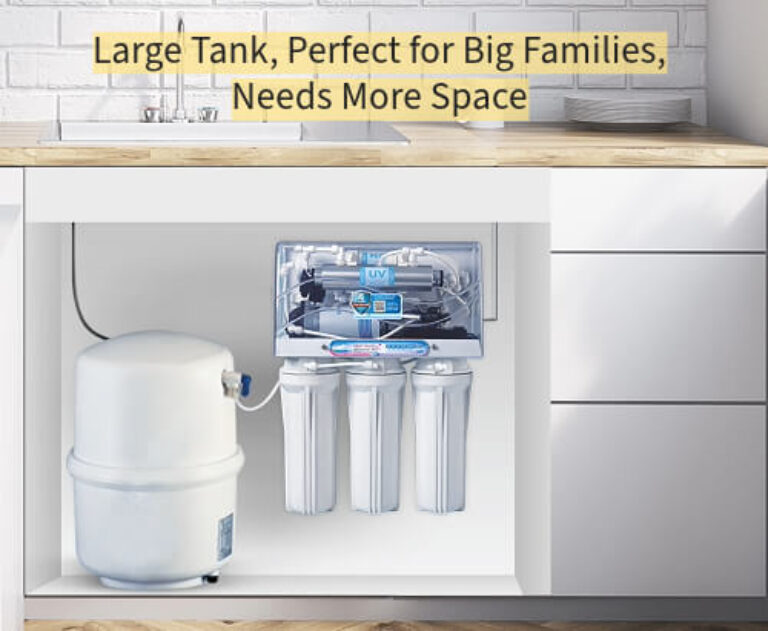
The Excell Plus features a large 7-litres storage tank and is therefore ideal for large families. But you must keep in mind that it needs a lot of space for installation.
Apart from under-the-counter installation, it can also be attached to water coolers and refrigerators with water dispensers.
Like all RO purifiers from Kent, this one too comes with a 1-year warranty and 3 years of free service AMC at zero cost. This offer will save you Rs. 3,000 directly.
Positive:
3 years of free service AMC worth Rs. 3,000
Sounds an alarm when membrane and filters need to be changed
A big storage tank of 7 litres
Alarm for UV-failure
Ideal for big families or homes with a higher requirement for purified water
Negatives:
No pre-filter is provided
100% of the water might not be RO purified (depending on the setting of the TDS controller)
The storage tank is given outside the purifier unit
Needs more space for installation
3. KENT Sterling Plus Under Sink RO Water Purifier
Compact Design, Suitable for Smaller Spaces
Another Kent addition, but this one incorporates a fresh design language.
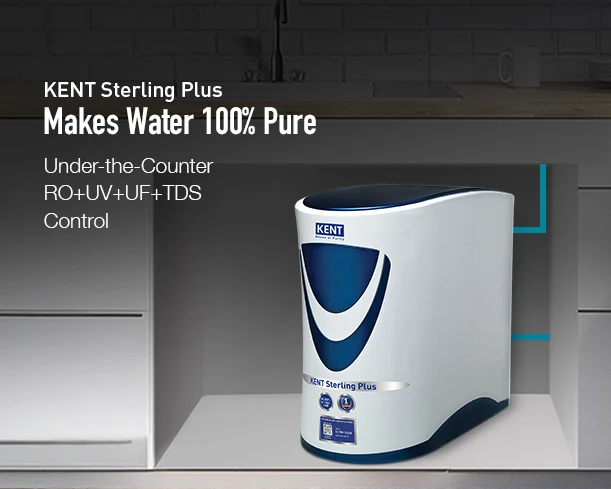
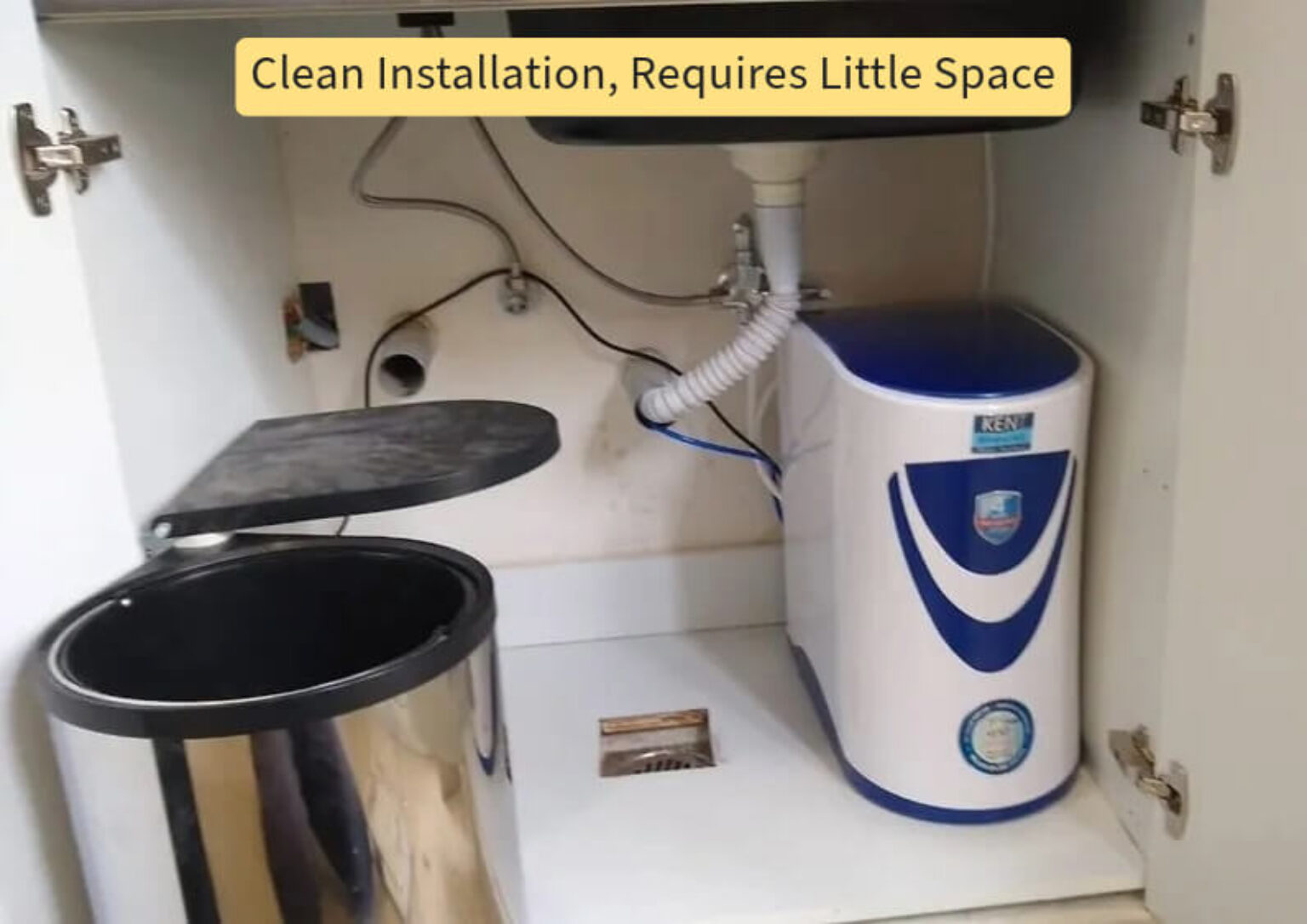
Unlike most under-sink RO purifiers, Kent Sterling Plus comes as a single unit. All the filters, membrane, and storage tank are kept inside the main unit.
The compact design makes it a great fit for smaller under-sink spaces. It is also comparatively much easier to install as compared to other under-sink purifiers that come with an external storage tank.
The intelligent design also makes it very easy to clean the area under the sink.
This model intelligently supports natural minerals even after very fine filtration. Making good use of Kent’s own patented Mineral RO tech. The TDS Controller retains essential natural minerals in purified water, giving you pure, safe, and natural-tasting water.
A lot of thought has gone into this under-the-counter water purifier, providing for side-by-side placement too, that may go right beside your refrigerators for utilizing the most space.
The patented technology helps with dishing out a tastier and sweeter end-product of fresh and safe water.
The double purification of RO/UF+UV manages to deal with any and all traces of Arsenic, Rust, and all other chemicals, bacteria, viruses, and even salts. 100% safely and purely filtered, and at the same time, nutritional too.
Kent Sterling Plus comes with a storage capacity of 6 litres and a high purification capacity of up to 15 litres/hour.
You get the standard 1-year warranty and 3 years of extended service with Kent Sterling Plus as well.
Positive
An additional 3 years service AMC package worth Rs. 3,000 is given free of cost
Comes as a single unit
If required, can be installed like a regular RO
Clean and compact design
Easy to install
Ideal for smaller under-sink spaces
Negatives
Does not come with an external pre-filter
100% of the water might not be RO purified because of the limitation associated with the use of a TDS controller
No alerts for membrane and filter change
Conclusion
In conclusion, choosing the right under-sink water purifier is crucial for clean and safe drinking water. We reviewed three top options in India.
The AO Smith Z2+ excels in filtration performance, compact design, and digital display. The Kent Excell Plus comes with a large storage tank, TDS controller, and 3 years of free service. Kent Sterling Plus is the compact version of the Kent Excell Plus and comes with identical purification stages.
Consider your needs, family size, space constraints, and budget. Choose a reliable option that suits your requirements and read customer reviews for informed decision-making.
According to a World Bank report, “water quality in India has deteriorated as a result of an uncontrolled discharge of raw domestic and industrial waste-water”. Indian cities are lagging behind in providing reliable, sustainable, and affordable water supply. Due to these disturbing trends, people are finding RO purifiers as the best option for drinking safe water.
What is RO Purification?
Discovered by Dean Spatz, Reverse Osmosis (RO) refers to a technique that uses a semi-permeable membrane in order to remove ions, molecules, dissolved salts, and larger impurities from drinking water. There are other types of membranes for water purification also, but the RO membrane provides the most effective & reliable water purification.
How Does RO Work?
When an artificial pressure pushes water through a fine RO membrane, the impurities present in the water get filtered out. The size of the pores of the RO membrane is very, very small. These pores allow only water molecules to pass through while preventing other contaminants.
RO purification is capable of filtering out up to 99% of over 60 different contaminants including lead, arsenic, mercury, fluoride, chlorine, etc.
According to The Hindu (March 2010), “Polluted drinking water claim more lives than all forms of violence, including war”. Therefore, it is a crying need of the hour to utilize an effective purification technology in the form of RO and UV that removes harmful impurities as well as deadly germs from the water we drink.
What is RO+UV Purification?
The RO+UV water purifiers employ both RO and UV technologies that give the safest water. Reverse osmosis is used for removing ions, molecules, and larger particles from drinking water. UV purification, on the other hand, is a disinfection technique that kills or inactivates microorganisms.
Top Selling RO+UV Water Purifiers in India
How does (RO+UV) work?
Reverse osmosis is the process that utilizes a semi permeable membrane, which allows pure water to pass through it, while stopping contaminants and impurities on one side. RO purification system is immensely helpful in removing all dissolved solids and bacteria.
Some of the RO systems use a process called Cross Flow, which helps the semi-permeable membrane to continuously clean itself. RO purification requires the application of pressure that pushes the fluid through the membrane. A residential RO water purification system uses an average pressure of 40psi. After RO purification, the water is allowed to go through UV system, which uses high frequency ultraviolet light to irradiate water through a glass element. Now, when the water is passed through the glass element, it becomes exposed to UV light. As a result, all bacteria and microorganisms get killed.
When to use RO+UV water purifiers?
The most important factor to consider before choosing an RO+UV water purifier is the water quality that is coming to our homes. If the water has large quantities of germs, chemicals, pesticides, fertilizers, herbicides, and heavy metals, then RO+UV water purifiers should be used.
The next factor to consider is TDS level. If the level of total dissolved solids in your water supply is 400-1500ppm, then RO+UV purifiers are recommended.
Usually, in India the borewell water contains TDS level of 300-500ppm, so these water purifiers might as well be used in those households that drink borewell water. RO+UV is the best combination of techniques utilized for water purification. Although, all the RO+UV systems run on electricity, but a high storage capacity allows them to store purified water in case of electricity outages.
Check out some top RO+UV water purifiers from brands like LivPure, HUL, and Nasaka.